Nov.09, 2026
A liner rarely fails at the moment of sealing. It fails weeks later — on a pallet in a warehouse, in a shipping container crossing the equator, or on a shelf in a market with 85% relative humidity. When a customer reports that the aluminium foil has curled away from the board or detached inside the cap, the root cause is almost never the seal itself. It is the laminate underneath it.
This article compares two constructions commonly specified for bottles and jars — the aluminum foil paper liner and the easy-peel ring liner — and explains why one drifts with the climate while the other does not.
A conventional foil paper liner is a four-layer build: water-absorbent paperboard, a wax and hot-melt adhesive layer, aluminium foil, and a PE heat-seal film. The foil sealing film is itself the aluminium layer plus its PE heat-seal layer.
The critical detail is the middle: the foil is bonded to the board by wax plus hot-melt adhesive, and wax melts at only 50–60°C. That bond holds the whole construction together, so the liner's structural integrity is tied to the weakest thermal link in the stack.
The board is the second weak point — by design. It is a sponge-like, porous structure, and that porosity is functional: after sealing it absorbs the wax and hot-melt residue. The same open structure, however, also absorbs water vapour from the air.
1. Heat above roughly 40–50°C. The wax–hot-melt bond softens or melts. Tack drops, the bond is partly absorbed into the board, bonding force is lost, and the foil detaches or curls. A container in direct sun, or a truck in summer, reaches this range easily.
2. Humidity above roughly 80% RH. The paperboard absorbs moisture, swells and deforms. Water vapour penetrates the bond line at the same time, so the foil lifts and the board warps.
3. Cold at around -15°C. Wax components crystallise. Once crystallised, the bond layer no longer has tack, and the foil detaches — the mirror image of the heat failure, from the opposite end of the temperature scale.
4. Opening. The board can stay adhered to the foil when the consumer peels the liner. A small flake of paper tears away at random, and the brand logo printed on the foil is covered by board fibre or wax residue. The usual remedy is to glue the board into the cap base, which raises the recycling cost of the closure.
The practical consequence is a narrow process window: production, transport to the filler, filling and sealing, and finally global distribution all have to stay inside a controlled temperature and humidity band. Once the product is on a shelf, that control is gone.
An easy-peel ring liner is a six-layer laminate, top to bottom: PET film / PE foam / PET film / PE film / aluminium foil / PE film.
Two properties make the difference:
Bonding is the third difference: the layers are laminated with a high-temperature-resistant adhesive, so interlayer strength does not depend on a low-melting component. Structural integrity is no longer hostage to ambient temperature.
The PE foam layer also does mechanical work: it fills the gap between cap and bottle finish and takes up tolerance, so the seal does not depend on the board's compressibility.
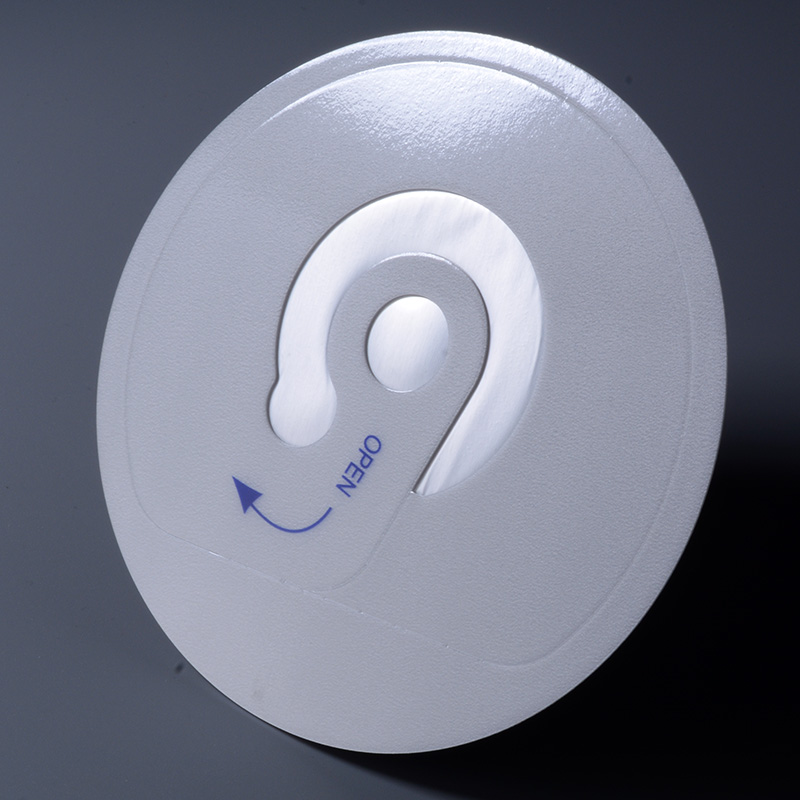
| Item | Easy-peel ring liner | Paper liner (foil paper) |
|---|---|---|
| Layer structure | Six-layer laminate: PET / PE foam / PET / PE / Al foil / PE | Four-layer bond: paperboard / wax + hot-melt / Al foil / PE |
| Interlayer bonding | High-temperature-resistant adhesive | Wax (m.p. 50–60°C) + hot-melt adhesive |
| Water absorption | None of the substrates absorbs water | Paperboard actively absorbs moisture |
| Heat resistance | No softening or deformation up to +50°C; layers melt at 105–660°C | Above 40–50°C the bond softens or melts; foil detaches and curls |
| Cold resistance | No change in physical properties down to -20°C | Around -15°C wax crystallises and the foil detaches |
| Humidity effect | No dimensional change or delamination | Above 80% RH the board swells and the foil lifts |
| Opening behaviour | No paper layer; no board adhesion, paper flakes or logo masking | Board adhesion, random paper flakes, logo covered; board often glued into cap |
| Quality consistency | Stable across the full range; consistent batch to batch | Fluctuates with temperature and humidity |
For teams qualifying a cap liner for export or for a product distributed across climate zones, four checks are worth putting into the specification:
A liner that passes at 23°C in the lab but delaminates after two weeks at 40°C / 80% RH is not a sealing problem. It is a material selection problem.
Why does the foil curl away from my paper liner in summer? The wax and hot-melt bond softens above roughly 40–50°C, loses tack, and can be partly absorbed by the paperboard. The foil then lifts or curls.
Can humidity alone cause liner failure? Yes. Above roughly 80% RH the sponge-like paperboard absorbs water, swells and deforms, while moisture reaches the bond line and weakens it.
What temperature range can an easy-peel ring liner handle? A six-layer PET / PE / aluminium construction with high-temperature adhesive stays stable from about -20°C to +50°C under natural conditions, with no softening, crystallisation or moisture deformation.
Is an easy-peel ring liner the same as a lift 'n' peel or ring pull liner? Buyers use the terms loosely across markets. Confirm the layer stack and peel mechanism with your supplier rather than relying on the name alone.
At Wanqi, we build our own converting and die-cutting processes around how these laminates actually behave — from the bond layer to the peel tab. If you are qualifying a liner for heat-sensitive contents, humid markets or long-distance distribution, send us your cap specification and target climate. We will recommend a construction and provide samples for line trials.
Technical note: 40–50°C / 80% RH / -15°C are field-experience thresholds. Melting points are typical published values (PET 262–263°C, Toray Lumirror®; LDPE 105–116°C, Dow / Dow-Mitsui TDS; aluminium foil ≈660°C). Values should be confirmed against the TDS of the specific grades used.
None
Looking for the Right Sealing Liner for Your Packaging?
Tell us your bottle material, contents, and sealing requirements — our engineers will recommend the best solution.
Navigation
Navigation
Contact Us
Tel.: +86 754 8998 1769
E-mail: lumy@wanqipk.com
Add.: One of the No.8 Fangxun Road, Jiudi, Outing Street, Longhu District, Shantou
Get in Touch
Get in Touch